

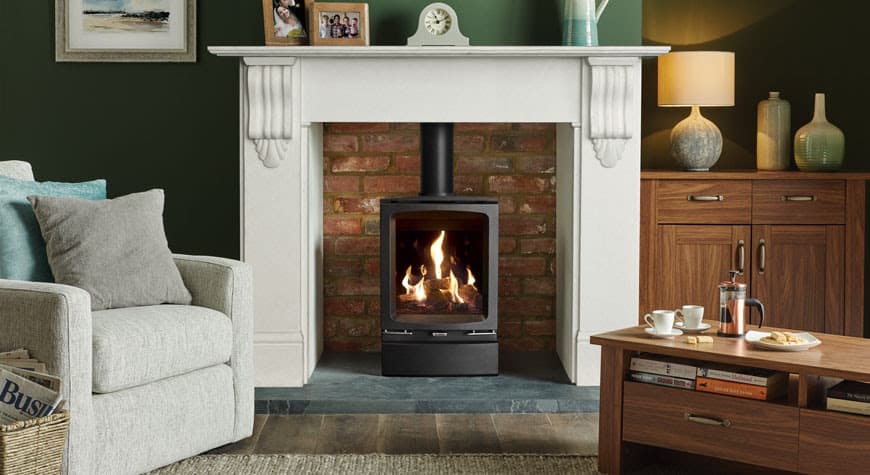
A real flame in the living room is one of the best upgrades you can make to a home, but it raises one big question early on: should you choose a gas stove or a wood burner? Both create a warm, welcoming focal point. Both can take the pressure off your central heating. Yet they feel very different to live with day to day.
At Lux Woodburners we supply and install both, with HETAS registered engineers for wood and multi-fuel stoves and Gas Safe registered engineers for gas. That means we have no reason to push you one way or the other. This guide sets out the honest differences in cost, convenience, installation and regulations, so you can choose the stove that suits your home across Essex, Kent or London.
The Quick Answer
Choose a wood burner if you want the crackle, scent and changing flame of a real log fire, you are happy to handle and store fuel, and you have a chimney or space for a twin-wall flue.
Choose a gas stove if you want instant, controllable heat at the touch of a remote, no ash or log storage, and the simplest route to a real flame in a smoke control area or a home without a chimney.
Most households already know which camp they fall into once they have weighed up lifestyle against atmosphere. The sections below will help you confirm it.
How Each Type of Stove Works
Wood Burning Stoves
A wood burner burns logs inside a sealed cast iron or steel firebox. Modern EcoDesign stoves use carefully controlled primary, secondary and tertiary air to burn the gases released by the wood, which delivers more heat from every log and far less smoke than an open fire. An airwash system keeps the glass clear so you can enjoy the flame picture. If you would like the option of burning approved smokeless fuels as well as logs, a multi-fuel stove gives you that flexibility.
Gas Stoves
A gas stove burns mains natural gas, or LPG on suitable models, over a realistic ceramic log or pebble fuel bed. You light it with a remote control, set your preferred temperature and let the thermostat do the rest. Our gas stove range includes models from Portway, Gazco and DRU, available in conventional flue (CF) versions that use a chimney, and balanced flue (BF) versions that vent straight through an outside wall.
Gas Stove vs Wood Burner at a Glance
| Factor | Wood Burner | Gas Stove |
|---|---|---|
| Flame and atmosphere | Real crackling log fire with natural scent and a flame that changes as it burns | Highly realistic flames over a ceramic fuel bed, consistent every time |
| Heat up time | Around 20 to 30 minutes to reach full output | Heat within minutes of switching on |
| Control | Adjusted manually with air controls and by adding fuel | Remote control with thermostatic settings on most models |
| Fuel | Dry, seasoned or kiln dried logs (multi-fuel models also take smokeless fuel) | Mains natural gas or LPG |
| Flue options | Existing chimney with a flexible liner, or a twin-wall flue system | Chimney or Class 1/2 flue (CF), or a room-sealed balanced flue through an outside wall (BF) |
| Installer | HETAS registered engineer | Gas Safe registered engineer |
| Ongoing upkeep | Regular ash removal, glass cleaning, annual sweep and stove service | Annual gas service, plus a sweep if it uses a chimney |
| Smoke control areas | Must be a DEFRA exempt stove burning suitable fuel | Gas is a permitted fuel |
Upfront and Installation Costs
The price of the stove itself is only part of the picture. The bigger variable is usually the flue: whether your chimney is in good condition, whether it needs lining, or whether a new twin-wall or balanced flue system is required.
To give you a realistic idea, here is how our current complete installation packages compare:
-
Wood burner fireplace packages start from £2,800 including VAT, with a choice of 5kW stove, flexible flue liner, chamber preparation, hearth and real oak beam.
-
Twin-wall wood and multi-fuel packages for single-storey extensions are £3,900 including VAT, for homes without a chimney.
-
The Portway Luxima gas stove package is £3,900 including VAT, covering the conventional flue stove, flue liner, brick chamber, hearth, oak beam and installation by our Gas Safe registered engineers.
London postcodes carry an additional £300 plus VAT on each package. Every installation comes with our 5 year workmanship warranty and a free carbon monoxide alarm.
You can browse individual models on our stoves and prices page, and we offer 0% deposit and 0% APR finance (subject to status) if you would prefer to spread the cost.
Running Costs: Which Is Cheaper to Use?
Running costs depend heavily on how you buy your fuel and how often you light the stove, so it is worth looking at each in turn.
Gas Stove Running Costs
Under the Ofgem price cap for 1 October to 31 December 2026, the average unit rate for gas paid by Direct Debit is 7.97p per kWh. As a worked example, a 4kW gas stove running at full output with an efficiency of around 78% uses roughly 5.1kWh of gas per hour. Four hours on a winter evening comes to about 20.5kWh, or roughly £1.63 for the gas used, excluding the daily standing charge. In practice, thermostatic models spend much of the evening ticking over at a lower setting, so the real figure is often lower.
Wood Burner Running Costs
A 5kW wood burner running at around 80% efficiency burns roughly 1.5kg of dry hardwood per hour at full output, so a four hour evening uses about 6kg of logs. What that costs depends entirely on how you buy. Bulk deliveries of good quality logs, particularly when bought ahead of the season, are typically much better value than small bags picked up as you go. Our guide to kiln dried vs seasoned logs explains how drying method affects cost and storage.
The biggest factor in wood burner running costs is moisture. Wet wood wastes energy boiling off water, so you burn more logs for less heat. Logs at 20% moisture or below give you far more warmth for your money.
A note on energy prices
The price cap is reviewed every three months, so gas costs will move over the winter. The figures above reflect the October to December 2026 cap and are national averages: your own tariff and region may differ.
Whichever stove you choose, the biggest saving often comes from heating the room you actually use and turning the central heating thermostat down in the rest of the house.
Maintenance and Upkeep
Looking After a Wood Burner
A wood burner asks a little more of you day to day. You will need to clear ash regularly, clean the glass now and again and keep your log store topped up. Our step by step guide on how to clean a log burner covers the essentials.
Once a year, it should have a professional chimney sweep (more often if you use it heavily) and a stove maintenance visit to check door seals, glass, baffle plates and air controls. Read how often you should sweep your chimney for guidance based on how much you burn.
Looking After a Gas Stove
Gas stoves are very low maintenance in everyday use: there is no wood ash or log fuel to carry in. Soot on the glass is not normal and should be checked by a Gas Safe registered engineer. They should still be serviced every year by a Gas Safe registered engineer to check the burner, flame picture, controls and safe venting of combustion gases. If your gas stove uses a conventional flue, the chimney should also be swept once a year to keep it clear of debris and nests.
Do You Need a Chimney?
Not necessarily, for either option. A wood burner can be installed into an existing chimney with a flexible flue liner, or into a home without a chimney using a twin-wall flue that runs through the roof or up an outside wall. Our guide on installing a wood burner without a chimney explains the options, and our freestanding stoves are well suited to twin-wall installations.
Gas is often the more flexible choice for homes with no chimney at all. Balanced flue gas stoves and DRU gas fires are room sealed and vent through a short duct in an external wall, which can open up positions that would be difficult for a solid fuel flue. Balanced flue models also tend to be the most efficient, with some in our range rated above 90%.
Smoke Control Areas and Regulations
Large parts of London, along with many towns across Essex and Kent, are designated smoke control areas. Government guidance explains that wood must be burned in a DEFRA exempt appliance, using only the fuel specified by its manufacturer. In England, councils can issue penalties of up to £300 for smoke emissions in these areas.
For wood burner owners, that simply means choosing a DEFRA exempt, EcoDesign stove and burning dry logs, which is exactly what we supply. Our wood and multi-fuel stove range is made up of DEFRA approved and EcoDesign models, and we will confirm the right choice for your postcode during your consultation.
Gas is permitted under smoke control rules, making a gas stove a straightforward option if you live in a densely built-up area. The appliance must still be installed and maintained safely.
Carbon monoxide safety
Since 1 October 2022, the guidance supporting Building Regulations in England includes a carbon monoxide alarm in the room when a new or replacement solid-fuel or gas stove is installed. Follow the alarm manufacturer’s placement instructions. Every Lux installation includes a free carbon monoxide alarm.
Environmental Considerations
Wood burners run on a renewable fuel. Logs from sustainably managed woodland release roughly the carbon the tree absorbed while growing, which is why wood is regarded as a low carbon fuel when sourced responsibly. The trade-off is fine particulate emissions, which is why stove design and fuel quality matter so much. A modern EcoDesign stove burning Ready to Burn logs produces a fraction of the emissions of an open fire or an older stove.
Gas stoves burn a fossil fuel and release carbon dioxide. A fair comparison with wood depends on fuel sourcing, processing, transport and appliance efficiency; wood should not be treated as automatically carbon neutral. At the point of use, however, they burn very cleanly, with no smoke and minimal particulate emissions inside or outside the home.
Which Should You Choose?
A Wood Burner Is Likely to Suit You If:
-
You want the full sensory experience of a real log fire
-
You have a working chimney, or room for a twin-wall flue
-
You have space to store logs and are happy to load and tend the fire
-
You would like a heat source that does not rely on the gas network
-
You enjoy the ritual of lighting the fire on a cold evening
A Gas Stove Is Likely to Suit You If:
-
You want warmth within minutes at the press of a button
-
You prefer no ash, no log storage and minimal cleaning
-
You live in a smoke control area and want the simplest compliant option
-
Your home has no chimney and a balanced flue through an outside wall would work
-
You already have a gas supply close to the fireplace
Still torn? Many of our customers compare the different types of wood burning stove alongside gas before deciding, and our team is always happy to talk it through.
See Gas and Wood Burning Stoves Side by Side
Nothing beats seeing a flame in person. Visit our showrooms in Leigh-on-Sea and Orpington to compare wood burners and gas stoves on display, ask our team anything and get a feel for the size, finish and flame picture you like best. We can also visit your home for a free consultation to check your chimney, gas supply and flue options before recommending the right stove.
Explore More from Lux Woodburners
Gas Stoves: realistic flames and thermostatic remote control from Portway, Gazco and DRU.
DRU Gas Fires: built-in conventional flue and balanced flue gas fires for a sleek, modern finish.
Wood and Multi-Fuel Stoves: DEFRA approved and EcoDesign stoves for a true log fire.
Supply and Installation: HETAS and Gas Safe installations across Essex, Kent and London, with a 5 year workmanship warranty.
Chimney Sweep: fixed price sweep of £80 with a certificate for your insurer.
Gas Stove vs Wood Burner FAQs
Is a gas stove cheaper to run than a wood burner?
It depends on how you buy your logs. Under the October to December 2026 price cap, gas averages 7.97p per kWh. Logs bought in bulk and stored well can work out cheaper per kWh than gas, while small bags bought as you go are usually more expensive. Gas stoves also avoid any waste from wet fuel.
Does a gas stove give out as much heat as a wood burner?
A typical gas stove produces around 3.5kW to 4.6kW, which comfortably heats most living rooms. Wood burners are commonly 5kW and above, so they can suit larger or open plan spaces. The right output depends on your room size and insulation, which we calculate during your consultation.
Can I have a gas stove without a chimney?
Yes. Balanced flue gas stoves and gas fires are room sealed and vent through a duct in an external wall, so no chimney is needed. Conventional flue models do need a chimney or a suitable Class 1 or Class 2 flue.
Can I use a gas stove in a smoke control area?
Yes. Gas is a permitted fuel in smoke control areas. If you prefer a wood burner in a smoke control area, it needs to be a DEFRA exempt model burning suitable fuel.
Do gas stoves need servicing?
Yes. A gas stove should be serviced once a year by a Gas Safe registered engineer. If it uses a conventional flue, the chimney should also be swept annually.
Can I switch from a wood burner to a gas stove later?
Often, yes, but it depends on your chimney, the flue liner and whether a gas supply can be run to the fireplace. A solid fuel liner is not automatically suitable for gas, so the flue needs to be assessed first. Our engineers can survey your property and advise on the best route.
Ready to Choose Your Stove?
Whether you have your heart set on a crackling log fire or the push-button ease of gas, our team will help you find the perfect stove for your home. Book a free consultation or call your nearest showroom today.
Essex Showroom (Leigh-on-Sea): 01702 780 888
Kent and London Showroom (Orpington): 01689 477 888